
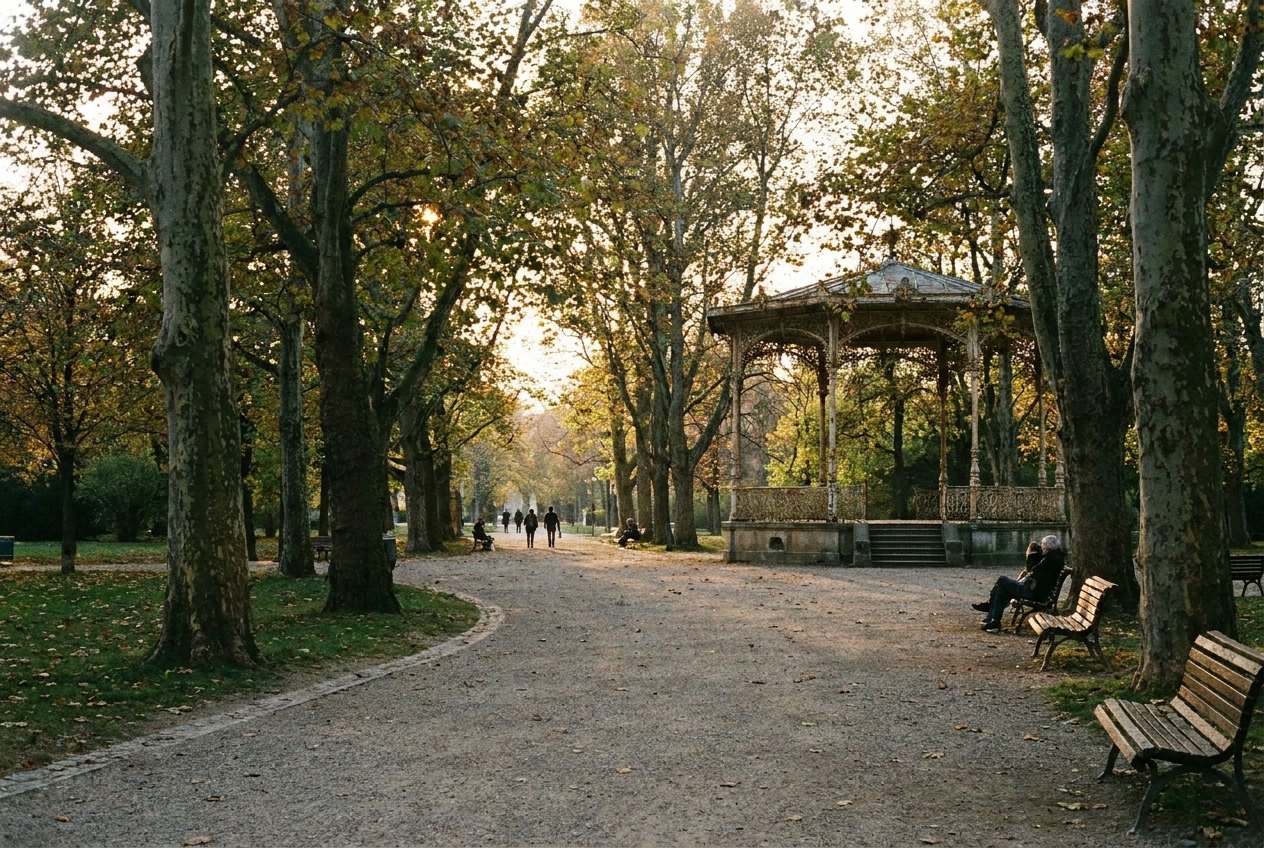
After the earthquake of 1880 and with the railway's arrival, Zagreb grew quickly onto the flat land south of the old hill towns. Its planners laid out the new Lower Town, Donji Grad, on a regular grid of wide streets, and threaded through it a chain of seven squares and parks in the shape of a U. The idea is usually credited to the city engineer Milan Lenuci, and the chain is known as the Lenuci Horseshoe or, more simply, the Green Horseshoe. It is lined with many of the city's grandest public buildings.
Zrinjevac and the eastern arm
Start at Zrinjevac, the first square south of Ban Jelačić Square. Its tall plane trees, a cast-iron music pavilion from the 1890s, fountains and a weather column make it the most elegant of the squares, and on summer evenings and weekends there are often concerts. Grand buildings line its sides, including the Archaeological Museum.
Continue south to Strossmayer Square, where the palace of the Croatian Academy of Sciences and Arts holds a gallery of old masters, and then to King Tomislav Square, facing the main railway station. Here the long, bright yellow Art Pavilion closes the view. Its iron frame was first used for an exhibition building in Budapest in 1896 and then brought to Zagreb, where the pavilion opened in 1898 as an exhibition hall. An equestrian statue of King Tomislav stands in front of the station.
see also, a few pages onMirogoj, the arcaded cemeteryThe Botanical Garden
At the base of the U, the Botanical Garden opened in the 1890s and belongs to the university. It has an English-style landscape garden, a small lake, rock gardens and a 19th-century glasshouse, and it is a calm green corner a few steps from the station. Opening times are seasonal, and the garden usually closes in winter.
The western arm
From the garden, walk north along the western squares. Marulić Square holds the old university library, a fine Secession building. Further north, the Republic of Croatia Square is dominated by the ochre-and-white Croatian National Theatre, opened in 1895 and designed by the Viennese architects who built theatres across the Habsburg lands. Facing it are buildings of the university, and in front of the theatre stands a well-known sculpture of a well by Ivan Meštrović.
How to walk it
The full horseshoe is a gentle walk of a couple of kilometres on flat ground. Allow half a day if you visit museums or the garden, or an hour for a simple loop. It is at its best in late afternoon and evening, when the light falls through the trees and the benches fill up with people reading, talking and watching the city go by. In December, the squares host Advent events and lights.
From Zrinjevac, it is only a few minutes north to Ban Jelačić Square, Dolac market and the climb into the Upper Town.