
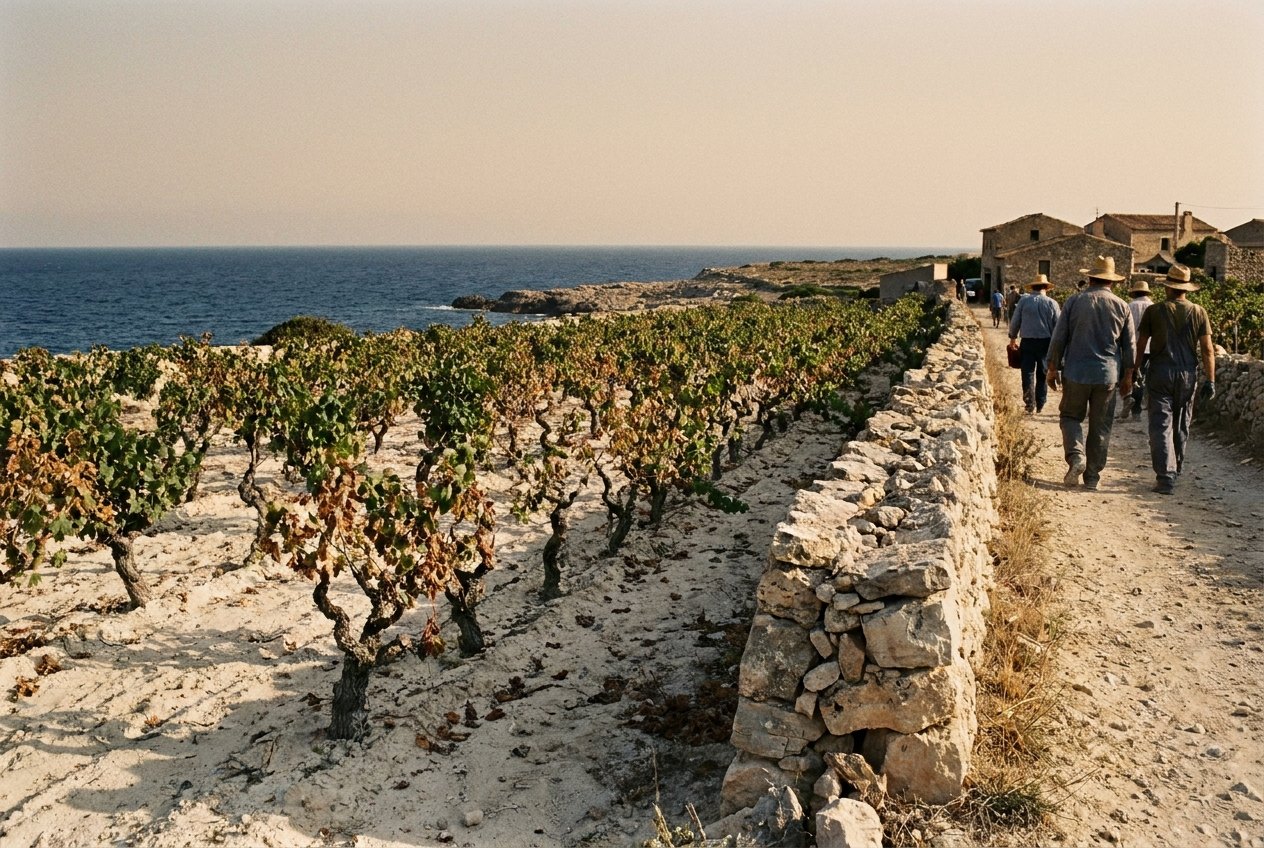
Lumbarda is a village at the south-eastern tip of Korčula island, about six kilometres from Korčula Town. Its houses are scattered over low hills and around small bays, among vineyards, olive groves and gardens. Two things set it apart from the rest of the island: its sandy soil, which gives rise to a unique local wine, and its sandy beaches, rare on a coast of rock and pebbles.
Grk, the wine of the sand
The fields around Lumbarda are made of fine, pale sand rather than the red earth and stone of most of the island. On this sand grows Grk, a white grape variety found almost nowhere else. Its name relates to the Greek word for Greek, a reminder of the island's ancient settlers, and also to the bitter edge in its taste. Grk vines have only female flowers and must be planted alongside other varieties to be pollinated, one of the reasons the wine is made in small quantities.
Several family wineries in the village offer tastings in season. Opening times are informal; ask in the village or look for signs.
The Greek inscription
Lumbarda's history goes back to antiquity. In the 19th century, a stone tablet was found here bearing a Greek inscription from around the 3rd century BC. It records the founding of a settlement by colonists from the Greek island colony of Issa, today's Vis, and lists how the land was divided among them. Known as the Psephisma of Lumbarda, it is one of the oldest written documents found in Croatia. The original is kept in a museum in Zagreb, and copies can be seen locally.
see also, a few pages onBadija, the monastery islandBeaches
Lumbarda's beaches are its other attraction. Pržina, on the southern side, is a sandy beach facing the open sea, with shallow water good for families. Bilin Žal, nearer the village, is smaller. In summer they get busy, but they are a welcome change from the rocks and pebbles of most of the Dalmatian coast. Smaller coves and rocky bays are scattered along the shore for quieter swimming.
From Korčula Town, Lumbarda is an easy trip. Buses run along the road; check the timetable in town. Cycling takes about half an hour along a gently rolling road, and in summer small boats and water taxis also run between the town harbour and Lumbarda. Walking is possible but the road has little shade.
Combine a morning on the beach with an afternoon in Korčula Town, or with a boat out to the monastery island of Badija, which lies between the two.