
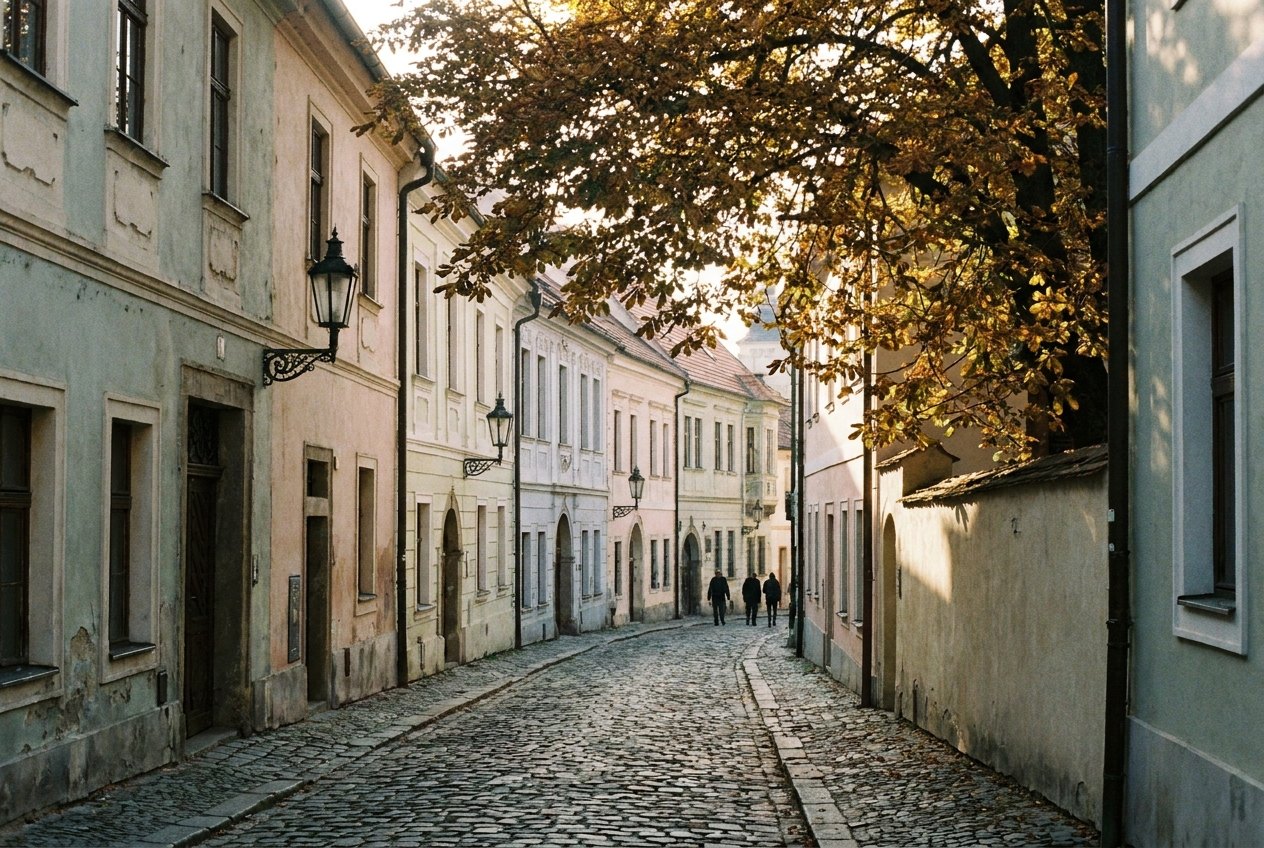
Zagreb began as two settlements on neighbouring hills. Kaptol, on the eastern hill, grew around the bishop's seat and its cathedral from the 11th century. Gradec, on the western hill, was a royal free town of craftsmen and merchants, walled in the 13th century. The two were rivals for centuries, separated by a stream, and they were joined into a single city only in the mid-19th century. Together they form the Upper Town, Gornji Grad, a quiet district of steep lanes, churches, palaces and museums above the busy Lower Town.
Much of the Upper Town was damaged in the earthquake of March 2020, and repairs to some churches and buildings are still under way. Check which interiors are open before you plan around them.
Up by funicular
Start in the Lower Town on Ilica, the long shopping street west of Ban Jelačić Square, and look for the small funicular that climbs to the Upper Town. It opened in 1890 and is one of the shortest public funiculars in the world, its track only a few dozen metres long. The ride takes about a minute. If you prefer to walk, stairs climb beside it.
At the top stands Lotrščak Tower, a 13th-century defence tower that once guarded the southern gate of Gradec. Every day at noon a cannon is fired from the tower, a tradition kept since 1877, originally so that the city's churches could set their bells to the same time. The tower can usually be climbed for a view over the rooftops of the Lower Town.
The promenade and St Mark's
From the tower, the Strossmayer promenade runs east along the old town walls, shaded by chestnut trees and lined with benches. It is a favourite place for an evening stroll and a fine spot for sunset over the city.
It is a favourite place for an evening stroll and a fine spot for sunset over the city.
Walk north through the lanes to St Mark's Square, the heart of Gradec. The Church of St Mark is small and Gothic, but its roof is famous: coloured tiles form two coats of arms, one combining the historic arms of Croatia, Dalmatia and Slavonia, the other the arms of Zagreb. The square is also the seat of power: the Croatian Parliament and the government building stand on either side of the church.
see also, a few pages onThe museum of things left behindThe Stone Gate
East of St Mark's, the lane leads downhill through the Stone Gate, the only one of the old town gates to survive. Inside its dark passage is a small shrine. Tradition holds that a painting of the Virgin Mary kept here survived a great fire in 1731 unharmed, and it has been venerated ever since. Candles burn in front of the iron grille at all hours, and people stop to pray on their way through. Stone plaques of thanks cover the walls. Walk through quietly.
Across to Kaptol
Below the Stone Gate, the street called Radićeva winds down to Tkalčićeva, a lively street that follows the bed of the old stream between the two hills, now lined with cafés and terraces. From here, it is a short climb up the other side to Kaptol and the cathedral, with Dolac market spread out just below it.
The Cathedral of the Assumption, with its two tall neo-Gothic spires, was rebuilt after an earthquake in 1880 and dominates the skyline of the city. It was damaged again in 2020, and work on the spires has continued for years since. Around the cathedral, parts of the old defensive walls of Kaptol still stand.
Notes for the afternoon
- The Upper Town is compact but steep; allow three or four hours with stops.
- The Museum of Broken Relationships and several other museums are within a few minutes of St Mark's.
- Combine the walk with a morning at Dolac market, just below Kaptol, and an evening in the parks of the Lower Town.