
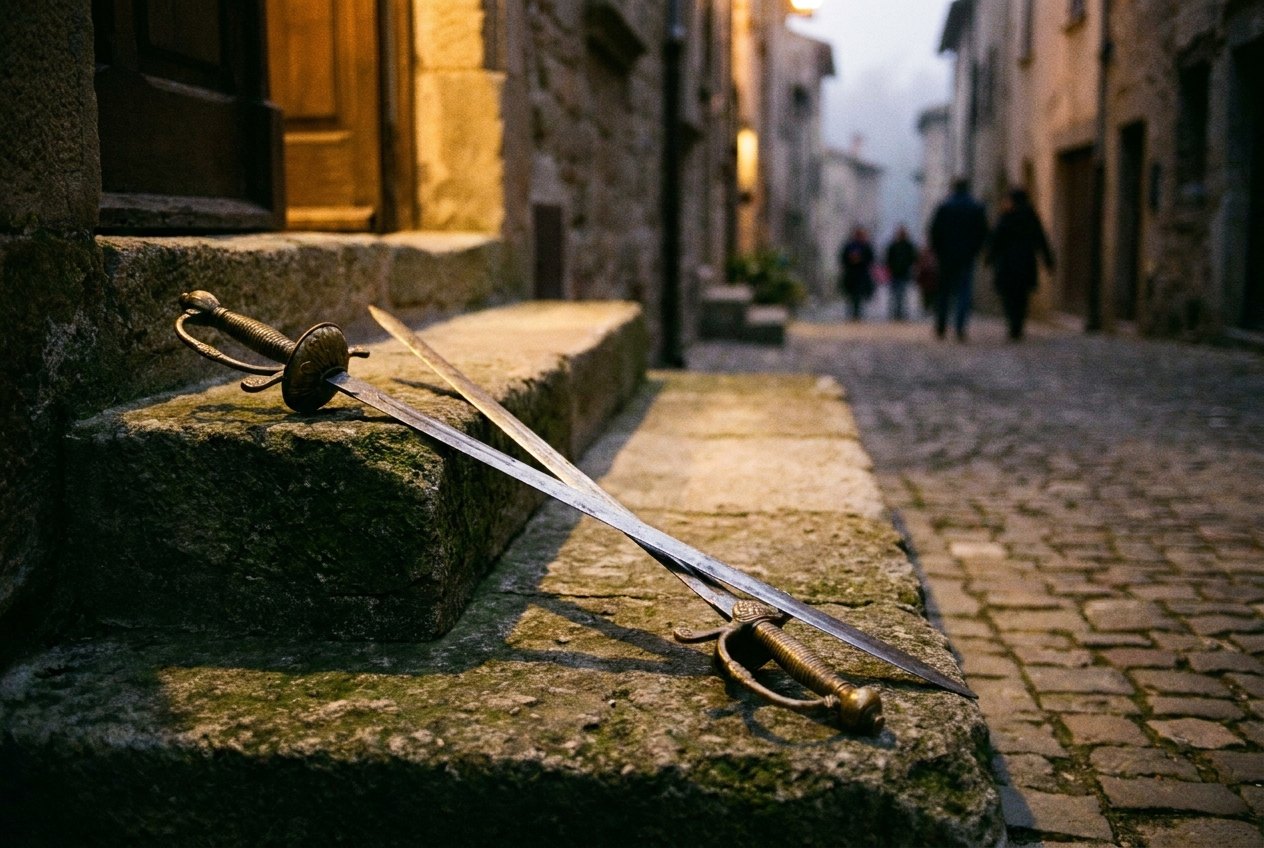
Moreška is a sword dance performed in Korčula Town, one of the last surviving examples of a type of dance once common around the Mediterranean, which acted out battles between Christians and Moors. It came to Korčula centuries ago, probably by way of the Mediterranean trading world, and the town has kept it alive when it disappeared elsewhere. Today it is the island's most famous tradition and one of the best-known folk performances in Croatia.
The story
The dance tells a simple tale. The black king, leader of the Moors, has captured the bula, a young woman beloved of the red king. The red king arrives with his army to free her. After an exchange of speeches, in which the bula refuses the black king and the two kings defy each other, the armies fight. The battle is danced in a series of figures, each with its own pattern of steps and sword strokes, until the black king is defeated and the bula is freed.
The dancers are men from Korčula, dressed in red or black, carrying a sword in each hand. They strike in time with brass band music, and the clash of steel, sometimes throwing sparks, gives the dance its drama. Being chosen to dance the Moreška is an honour passed down in families.
see also, a few pages onKorčula Town, built like a fishboneWhen and where to see it
Traditionally, the Moreška was danced once a year, on the feast of the town's patron saint in late July. Today, it is performed regularly on summer evenings for visitors, usually in an open-air space just outside the old town walls near the Land Gate. Performances last about an hour, including the speeches.
Other sword dances on the island
Korčula has other sword dance traditions besides the Moreška. Several villages in the island's interior and west, such as Vela Luka, Blato and others, have their own dances called kumpanija, performed by companies of dancers with swords, a flag bearer and drummers, often on village feast days. They are less theatrical and more communal, part of the life of each village, and they show how deep sword dancing runs on the island.
Watching well
- Arrive early for a good view; seats are often simple stone steps or benches.
- The swords are real and loud. Young children may find the noise frightening at first.
- Photography is usually allowed, but flash is not welcome during the fight.
After the performance, walk the old town in the evening light, or, if you are staying in the west of the island, ask in Vela Luka when the local kumpanija is next performed.